The planning of an event goes beyond selecting the venue, working with vendors, and creating an event schedule.The lack of a schedule will make any preparation challenging once the event begins, as the vendors may come at various times, some events overlap, and delays can ruin the whole process.
A timeline allows for the integration of all these aspects. A event timeline gives you an idea of the tasks that need to be done and their order, who needs to do what, and how one activity relates to another. The best timelines also take into account the need for transition periods and flexibility.
Regardless of whether you plan a wedding, corporate event, birthday, conference, or another type of event, you can use a good timeline to guide you through the process.
1. Start With the Event’s Fixed Points
One of the simplest methods of developing a successful event timeline is through identifying events that have predetermined or challenging times. This creates a base on which the other components of the event can be based.
To do so, it is important to identify when the event starts, when the guests will arrive, ceremony/opening, meals, speeches, entertainments, presentation, closing and time of leaving the venue. If the event has already been booked or confirmed for the same time with a certain speaker, caterer, entertainer or any other supplier, then this event should also form part of the fixed events.
After identifying the fixed times, then it is possible to find out what needs to be done before the fixed times. Guest arrival may involve registration, setting up of seats, testing of sound and light systems among others.
2. Break the Day Into Clear Event Phases
A full-day schedule can get confusing if all the activities are listed in a single continuous line. Having distinct phases in the timeline of the day allows for better understanding of the schedule by the event team.
Preparation of the event is the first phase. This includes such activities as venue entry, furniture arrangement, decoration installation, audio-visual set up, caterer preparations, equipment checks, and the final inspection.
Guest arrivals and program execution make the next phase of the schedule. Activities here may vary depending on the nature of the event – it can be registration, seating, opening ceremony, speech making, presentation, meal serving, entertainment, and networking, among others.
Closing down and dismantling of equipment comes last. This can include such activities as final announcements, departure of the guests, collection of equipment, decorations dismantling, cleaning, and venue turn-over.
These phases will vary depending on the nature of the event since a wedding, conference, birthday celebration, or a company launch will require different schedules.
3. Give Every Task a Realistic Time Slot
A scheduled event timeline should be based on how long each activity will take place and not only what needs to be done.
In making estimates of duration, think about the entire process of the activity. For instance, food services may involve more than the duration it takes for guests to eat the food.
The may also have some duration within which to set up the service, coordinate with other members of the team, and clear away after the guests finish eating. There is also a program change, and there could be some duration required for its implementation.
Transitions should also be considered since they could involve movement of guests from one place to another, rearrangement of a room, bringing in a new speaker, getting ready for entertainment, and technical preparation.
Do not fill every single minute with an activity because a schedule without any gaps between each activity can be hard to follow when the previous activity has taken more time than anticipated.
It should be realistic yet detailed.
4. Assign Responsibilities to Every Timeline Item
Knowledge of what needs to take place is not enough for event planning. It is also necessary to know who will execute these plans.
Identify the person or team that is responsible for each of the important tasks on the timeline. This will depend on the event itself, but may include such individuals and/or teams as the event coordinator, the venue team, the caterer, the décor team, the DJ, the MC, the photographer, the registration team, the technical team, or the equipment vendor.
An easy format will help organize this information well:
Time | Activity | Responsible Person | Notes
Here is one possible way of writing an entry: “Sound testing is performed during this period by the technical team.”
This will help avoid any confusion while the timeline is being executed, since everyone will understand who is supposed to do a particular job. The event timeline will assign a certain responsibility to the right team.
It will be especially helpful while several vendors work within the same venue.
5. Coordinate Vendors and Event Equipment
Vendors can have a substantial impact on the event timing process. Hence, their arrival, setup, testing, service, and departure times must be taken into account when developing the timeline.
Identify key suppliers who will take part in the event and decide what time each of them will require access to the location. According to the nature of the event, these can be table and chair suppliers, staging, lighting, sound, decor, catering, entertainment, or any other vendors providing hired equipment.
It is important to consider interdependencies between vendors since some teams will have to wait for others to finish their work in order to start theirs. For example, some equipment can have to be positioned before the decorating process ends, while entertainment may require prior connecting and testing the sound equipment.
Taking into account such interdependencies in the event timeline can help to avoid unnecessary conflicts.
At the same time, the timeline will need to distinguish between vendor arrival time and the time of completing its setup because the arrival of a vendor does not necessarily mean that its preparation is finished.
6. Build Buffer Time Into the Event Schedule
No matter how well the schedule has been crafted, changes can still happen on the day of the event. There may be difficulties getting guests seated, speech can overrun, there can be technical issues, or there can be other delays.
Rather than plan everything to be completed at precisely the intended time, allow for some reasonable degree of flexibility.
How much buffer time is required depends on the particular event. Private events can be planned without as much attention as large-scale events involving various vendors, many segments in the programme, or more than one event space.
Think about what will cause problems for further items on the schedule. If there is an activity which has an effect on a number of subsequent events, having some flexibility in regard to this point makes planning easier.
It is also wise to think about how the team will cope with a delay before the day comes. The backup strategy can include cutting down transition, changing the order of certain activities, or using a flexible programme item.
A good schedule of events does not predict all potential problems. It is a schedule which allows some flexibility for dealing with changes in plans.
7. Review, Share and Update the Timeline Before Event Day
Before the event starts, go through the entire timeline from beginning to end. Check whether there are any gaps in the setup process, any unclear responsibility allocations, unreasonable time allocations, vendor conflicts, and any activity that relies on a previous activity being done first.
Check whether the programme activities along with the background activities have been included in the schedule. Setup, testing, vendor entry, meal preparation, equipment collection, and venue turnover are all as important as visible programme activities.
After reviewing the schedule, give the right version to those concerned. The event coordinator, vendors, venue team, MC, technical team, and other relevant participants need to be aware of the schedule sections related to their responsibilities.
One version of the schedule needs to be kept up-to-date and serve as the primary version. In case of a change in the schedule before the event, update the event timeline and not give everyone a different version to work from.
On the day of the event, an abbreviated version with time, activity, responsible party, and any notes may prove handy for the team.
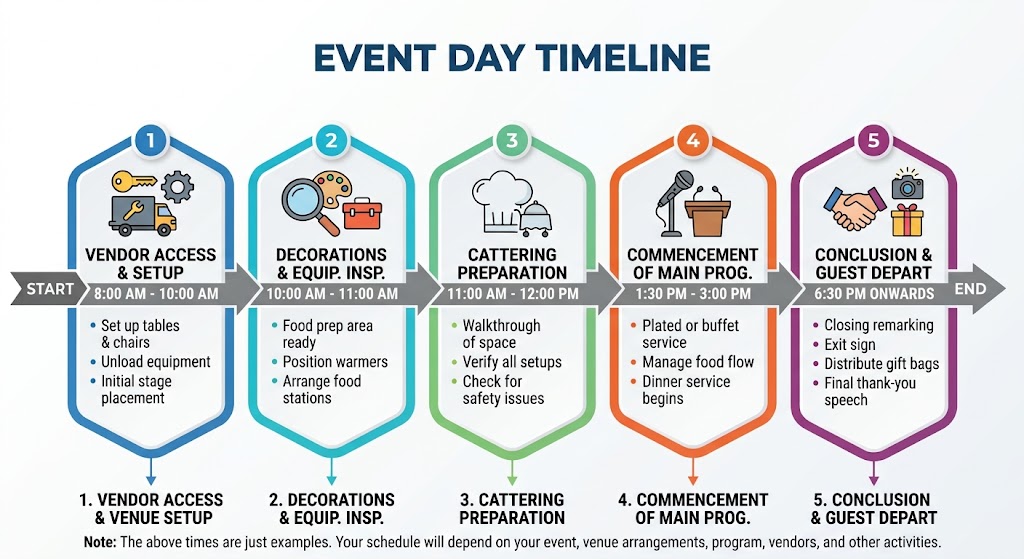
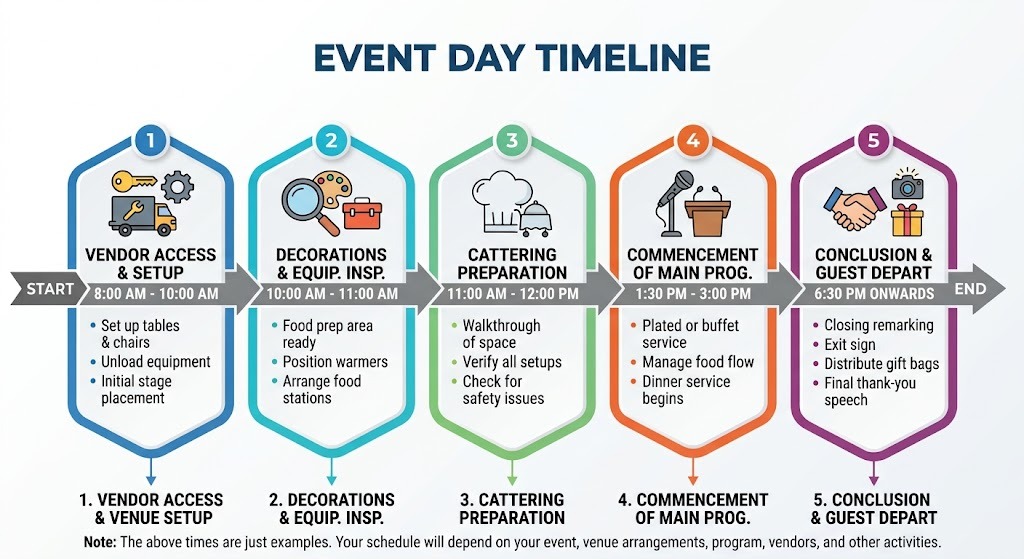
Event Timeline Example
An example event day schedule can be as follows:
8:00 a.m. – Vendor access and venue set up
10:00 a.m. – Decorations and equipment inspections
11:00 a.m. – Catering preparation
12:00 p.m. – Final venue inspection
1:00 p.m. – Guests arrive
1:30 p.m. – Commencement of main program
3:00 p.m. – Meal services
4:00 p.m. – Speeches and entertainment
6:00 p.m. – Conclusion activities
6:30 p.m. – Guests depart
The above times are just examples. Your schedule will depend on your event, venue arrangements, program, vendors, and other activities.
Common Event Timeline Mistakes to Avoid
One issue that arises when creating a timeline is filling it with too many activities such that no room remains for transitions.
Some of the other issues include the omission of vendor setup and teardown, lack of assigning of tasks, underestimation of duration of activities, overlooking limitations of the venue, and failure to update the schedule.
An event timeline should never be made for the sake of making a timeline. It should serve some purpose.
Frequently Asked Questions About Event Timelines
What is an event timeline?
Event timeline refers to a chronological timetable which indicates what events are going to be conducted, preparations, transitions, and close out needs in order to make the event run smoothly.
How do you create an event timeline?
One starts by looking at fixed times, indicating activities that will have to occur surrounding these fixed times, establishing realistic time frames for the activities, allocating responsibilities, coordinating with the vendors, having some flexible periods, and reviewing the timetable prior to sharing it with others.
What information does an event timeline contain?
A good event timeline will have time, activity to be conducted, the person in charge of that particular activity, location, set-up needs, transition time, vendor needs, and other relevant information.
Call to Action
When there is a good event timeline, then everything becomes clear regarding what should happen on that particular day. With fixed points, scheduling of activities into different stages, giving of real time to each activity, delegation of tasks, coordination of suppliers, giving of leeway, and pre-event review, an operational plan can be made.
Add a Practical event Timeline Template to Improve the Closing Call to Action