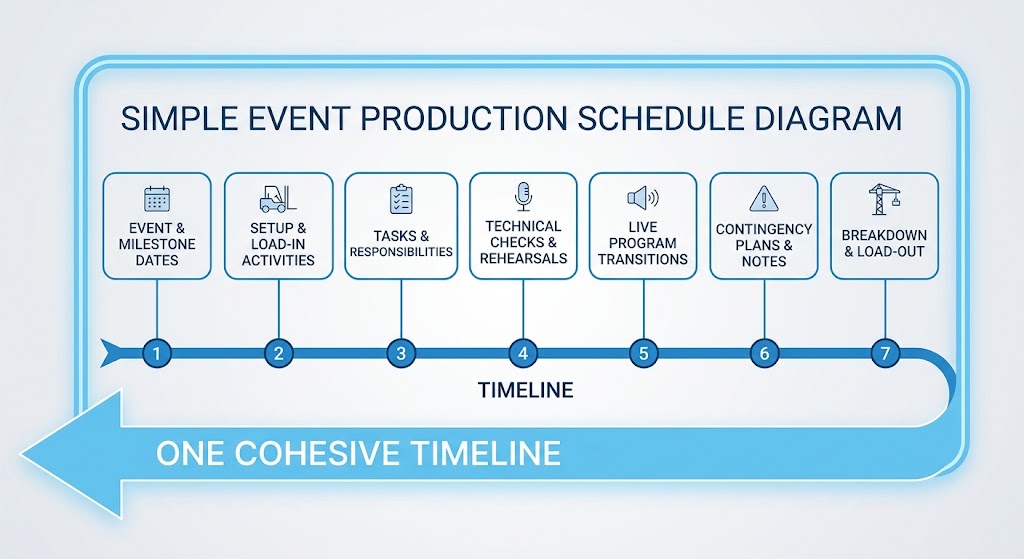
An event production schedule helps organize various aspects of the event into a structured timeline. This includes issues such as accessing the location and setting up the equipment through technical inspections, guest arrivals, program activities, and cleanup, among others.
Lack of an event production schedule leads to missing out on some important activities, while other teams will have no clue as to the time at which they should do something.
An organized event production schedule provides a reference point for the production team as to what should happen, when, where, and who should do it.
The following seven key factors are applicable to a variety of events including weddings, business events, conferences, concerts, or even personal parties.
What Is an Event Production Schedule?
The production schedule for an event is a plan that lists the activities that need to be undertaken during the planning, execution, and completion of an event.
While an event schedule highlights the activities that take place during an event, the production schedule also highlights those activities that occur behind the scenes in order to deliver the show.
These activities may include delivery of equipment, setup at the venue, staging, lighting, sound check, rehearsal, technical activities, guest arrivals, and transitions of the program.
A good schedule should relate all activities to particular times and people involved. It can also include location and other details useful to the production team during the event.
7 Essential Elements an Event Production Schedule Should Include
The practical event production schedule must take into account the entire timeline of the event rather than just the main program. The seven factors below offer an efficient way of arranging the schedule.
1. Date and Time of the Event and Major Milestones
Identify all the fixed times that will guide the whole production process.
Some of these may include the date of the event, time of access to the venue, setup, technical rehearsal, arrival of guests, starting of the event, major programs, end of the event, and time of equipment removal.
After identifying these milestones, other processes can be planned around them. For instance, if the arrival of the guests is at 3:00 PM, then equipment setup, sound check, and light checks must have been done before.
2. Setup and Load-In Activities
Everything that is to be done prior to the beginning of the event should be clearly depicted in the schedule.
This could include the arrival of equipment, the unloading process, setting up the stage, installing lighting, the installation of sound equipment, the positioning of furniture, the installation of decor, the set up of the registration desk, and the completion of technical procedures.
All of the activities should be laid out in order. There are some tasks which require that some other task should be completed first. For instance, the technical team may have to wait until the stage is set up.
3. Tasks, Responsibilities and Crew Assignments
Every significant production task should have a clearly identified person, team, or supplier responsible for completing it.
A simple schedule can use columns such as:
| Time | Task | Location | Responsible Team | Notes |
| 8:00 AM | Equipment delivery | Loading area | Production team | Confirm access |
| 9:00 AM | Stage setup | Main hall | Stage team | Coordinate with lighting |
| 11:00 AM | Soundcheck | Main hall | Audio team | Test microphones |
| 1:00 PM | Technical rehearsal | Main hall | Production team | Full walkthrough |
This structure turns the schedule from a list of activities into a working production document. Team members can identify their responsibilities and the timing associated with them.
4. Rehearsals and Technical Checks
Technical preparation must have a separate time set aside in the event production schedule.
This depends on the type of event; it can be done as soundchecks, microphone checks, light checks, presentation checks, stage walks, rehearsals by performers, and overall technical rehearsals.
The rehearsals can also help the relevant teams sort out the flow of the program prior to the arrival of guests for the event. Where the event requires speakers, performers, presentations or technical cues, the schedule must provide for this.
This must be done ahead of the event.
5. The Event-Day Program and Transitions
The production timeline must show what activities will be carried out after the commencement of the event.
These activities can include arrival of the guests, registration, welcome speeches, speeches by other speakers, performances, presentations, provision of food and beverages, entertainment, and finally closure of the event.
The timeline must not include major activities alone; it must also consider the transition activities.
In case a speaker concludes his/her speech before the performance, there could be activities carried out by the production crew.
Examples include changing of the microphone, lighting the stage, preparing for the next act, among others.
6. Contingency Time, Notes and Dependencies
A schedule of production should include those activities which are dependent on other activities.
In the same way, for instance, a performer’s practice would be dependent on the stage being ready whereas sound checking would be dependent on the installation of audio equipment.
A notes section could also be included in which one may put specific instructions, access details, technical needs, and coordination needs.
It is also important to allow some kind of flexibility regarding those activities which might consume more time than anticipated.
It will all depend on the kind of event being organized.
7. Breakdown, Load-Out and Venue Handover
The event production schedule must be extended even after the completion of the event.
After all the participants have left, there is a possibility that there will be a need for equipment to be turned off, staging to be dismantled, decor to be removed, equipment packed, hired equipment collected, waste cleared, and the venue prepared for handing over.
The supplier’s leaving time as well as any venue handing over the deadline should also be included in the production schedule.
It will ensure that the event production schedule does not end abruptly with the completion of the last item on the agenda.
What Should an Event Production Schedule Look Like?
Event planning schedules can be done using tables to make it easy for people to see what must be done.
| Time | Activity | Location | Responsible Team | Notes |
| 8:00 AM | Equipment delivery | Loading area | Production team | Confirm access |
| 9:00 AM | Stage setup | Main hall | Stage team | Coordinate with lighting |
| 11:00 AM | Soundcheck | Main hall | Audio team | Test microphones |
| 1:00 PM | Technical rehearsal | Main hall | Production team | Full walkthrough |
| 3:00 PM | Guest arrival | Entrance | Registration team | Registration ready |
| 4:00 PM | Event begins | Main hall | Event team | Start program |
| 8:00 PM | Event ends | Main hall | Event team | Begin approved breakdown |
Timing will differ based on the type of event, location, production needs, suppliers, and schedule.
How to Build an Effective Event Production Schedule
Start with the determination of the points which will be fixed and not easy to change like the times for access to the venue, arrival of guests, start of the event, end of the event, and the time for handing over the venue.
Add to the list the production activities needed before and during the event. Start working backwards from the guest arrival times and the start times of the program to figure out the times for other activities.
Allocate a person responsible for each significant activity. Add locations and notes for those activities which will be helpful for operational purposes.
The last step is to go through the schedule with the people who are involved in production, venue management, technical services, catering, decorations, entertainment, etc.
Event Production Schedule vs. Run of Show
An event production schedule is concerned with the overall time frame of an event’s operations. It could entail aspects such as getting into the venue, equipment deliveries, set up, technical preparation, rehearsals, events activities, breakdown and load out.
A run of shows, on the other hand, would be concerned with the timing of the program during the event. It could entail details such as who comes on stage when.
The two schedules could complement each other since the production schedule could offer the bigger picture, while the run of shows could give the smaller picture of the event program.
Frequently Asked Questions About Event Production Schedules
What should an event production schedule contain?
It should contain key dates and times, production activities, responsibilities, venues, setup, technical check, rehearsals, event day activities, transitions, notes, contingency planning, breakdown, and load out.
Who makes an event production schedule?
The schedule might be made by an event producer, production manager, event planner, or any other individual managing the event operation logistics. Related teams and suppliers can then contribute to the parts that concern their activities.
How does an event schedule differ from a production schedule?
An event schedule usually concentrates on the activities performed by the attendees, whereas a production schedule involves both the guest activity program and behind the scene logistics needed to run it.
When should an event production schedule be produced?
This schedule should be made after the key event elements and production needs have been clearly defined, and it should be updated as the supplier, timing, venue, and program details are being finalized.
Call to Action
An organized event production schedule ties up the logistics of the event in one comprehensive timeline. With the inclusion of important milestones, setups, roles, technical verifications, program changes, dependencies, and strike operations, an event management team can use the same event production schedule.
What is essential is for the schedule to convey in a structured way what needs to be done, when it needs to be done, where it needs to be done, and by whom.