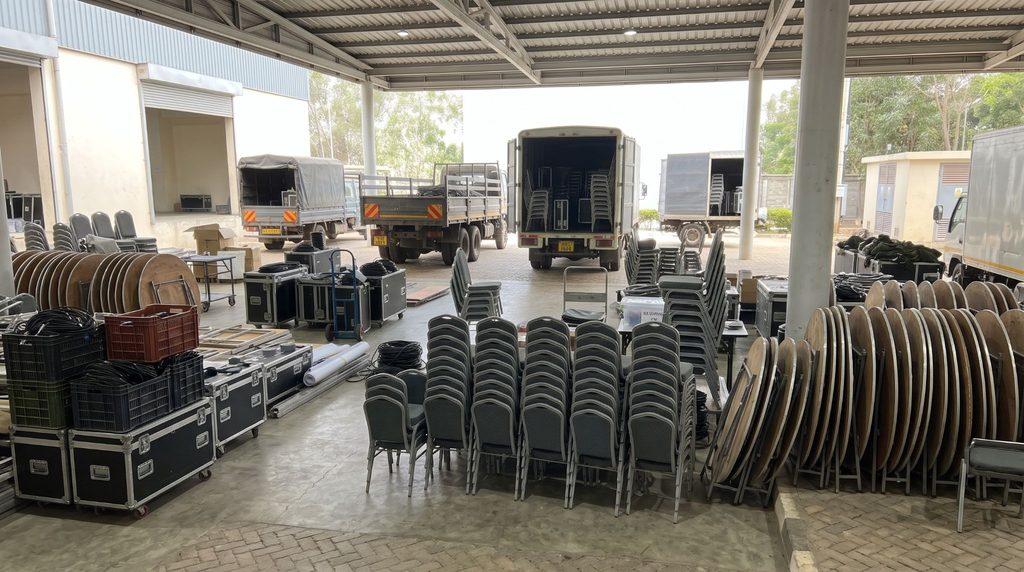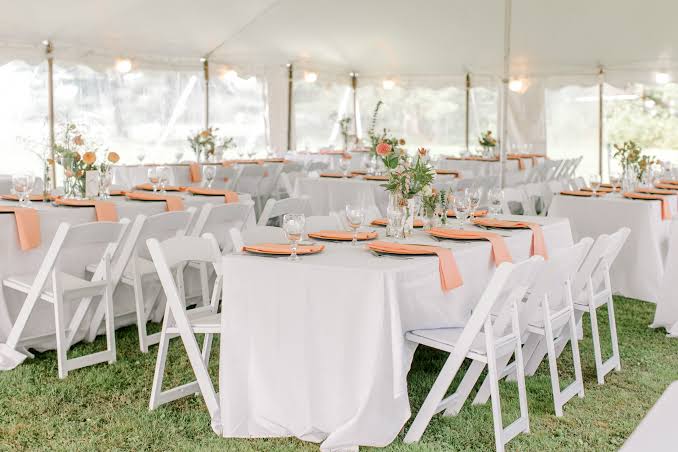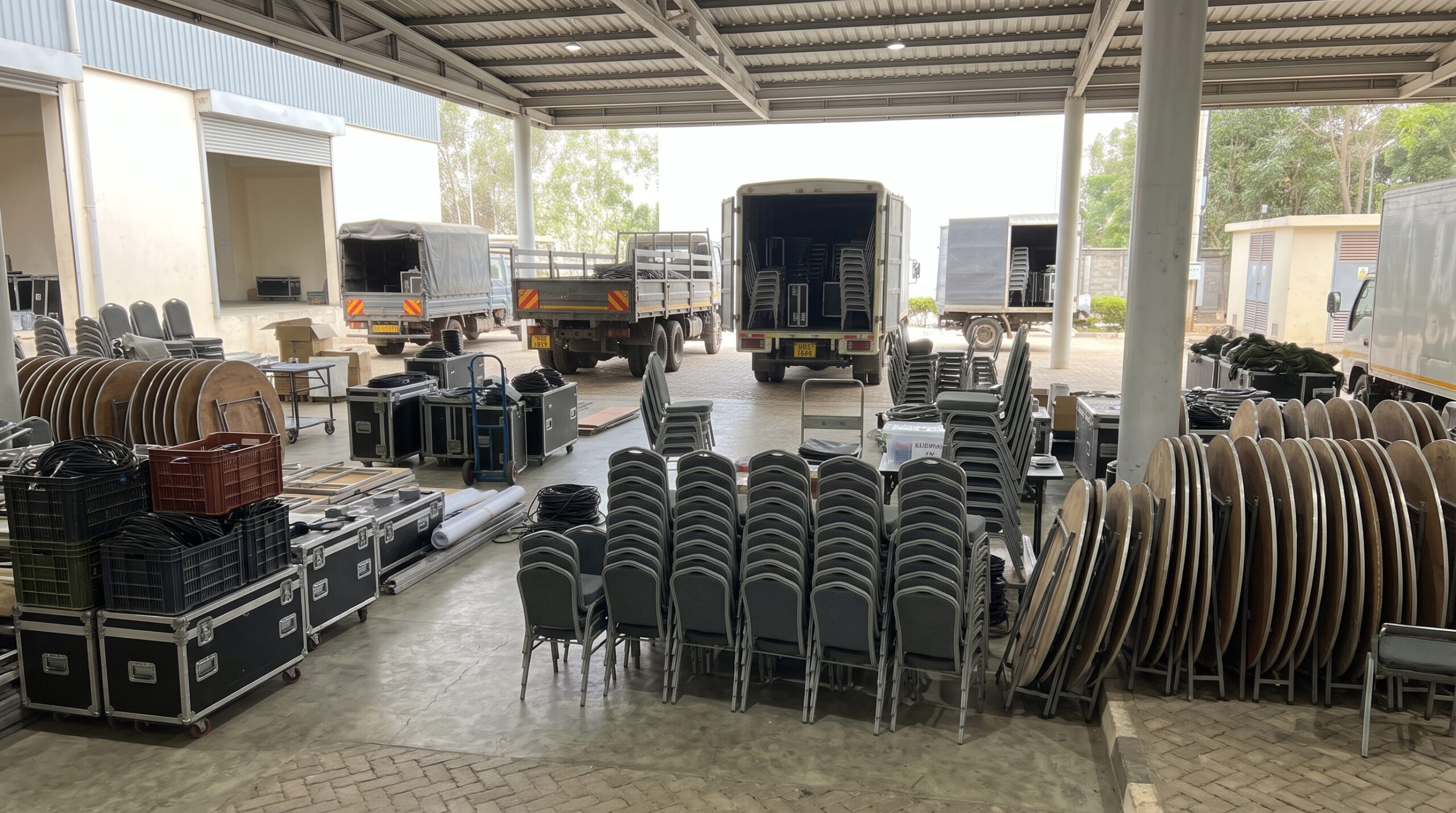
You have done a great job and now it is time to wrap things up. Your last guest leaves smiling, but now you notice that the chairs are accumulating, the cords are strewn everywhere, and the decorations have been messed up.
Loading out and equipment collection after the event is one of the most challenging responsibilities of an event manager or coordinator. In case you don’t plan and organize the load out and equipment collection of your event equipment, you are likely to lose in two aspects: financial and energetic.
You could end up using all your budget for replacement of either lost or damaged materials. Reverse logistics management will help you organize your load out in terms of collecting your rented event equipment. Whether you have organized a corporate or wedding event in Nairobi, below are 9 tips to ensure that your event equipment collection goes well.
1. Make a Bulletproof Master Inventory List
The logistics needed for an effective deconstruction and equipment collection of the event must be started at least a few weeks before the event. It would be an absolute disaster if you tried to recall the number of extension cords that were hired at 2:00 am in the morning after working 14 hours straight.
An infallible master list of inventory is what you need which includes everything that was taken to the venue. As soon as you get this list done, the whole process of deconstruction will become as simple as ticking off the boxes.
Organization of inventory:
Divide your inventory into different categories like Audio visual, lighting, seating and decor.
More than one vendor:
In case there are more than one vendors supplying equipment to you, make sure to note down the name of the particular vendor next to the equipment.
Serial number:
For expensive equipment such as speakers and projectors, maintain the serial numbers.
2. Create a Dedicated ‘Logistics Champion’
When the event is over, it is highly likely that the lead coordinator will be busy bidding farewell to the VIPs, dealing with the payment issue and coordinating the team members.
It is important that the lead coordinator does not undertake the job of chair folding and microphone packaging. It is important that there is one highly organized team member who acts as the Logistics Champion to ensure that the process is smooth.
Job Assignment for Single Person:
The Logistics Champion will manage the loading dock, inventory transport from the venue for equipment collection and vendor sheets.
Gatekeeper:
The equipment cannot leave the venue until it is struck off the inventory list by the Logistics Champion.
Decision Making Authority:
It is important that the logistics champion has decision-making authority to tie up loose ends with the vendors.
3. Implement Strict Pre- and Post-Event Inspections
The worst situation happens when after organizing a successful event you receive a bill stating that the equipment was broken and it needs repairs despite the fact that it was broken even before its arrival. Quality control should be your savior from these additional costs. Implement a two-stage procedure for quality control:
Checking upon Arrival:
Before receiving the equipment from Lumi Events and other providers spend five minutes checking the condition. It is very important to take pictures of scratches on the flight case, frayed wires, and check electronic devices right away.
On Breakdown Checking:
The same procedure should be applied before returning the equipment back for equipment picking up. Pictures should be made and a small “sign-off form” should be used.
4. Master the Art of Color-Coded Labeling
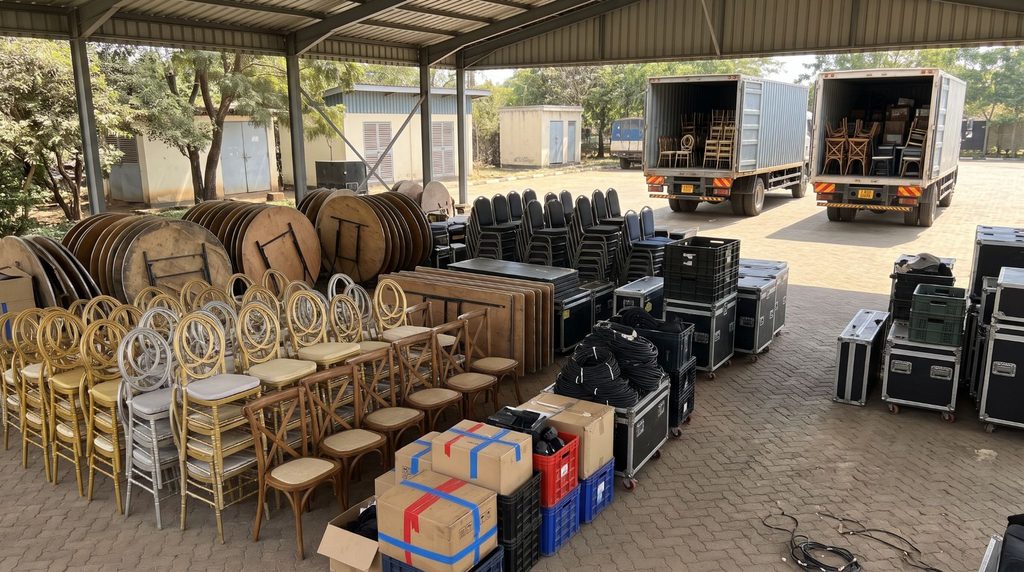
When the lights go on, then the process of disassembly and equipment collecting begins. Time is crucial. In case when all the equipment provided by the caterer, AV company, and the decorator is accumulated, it will take a very long time to sort it all out. The utilization of visual indicators will help avoid errors and will speed up the process.
Color Code for Each Vendor:
Every vendor has a color code for him/herself. Thus, the Lumi Events’ equipment is colored in blue while the catering equipment is red-colored.
Color Labels:
Use colored gaffer tape and zip ties to organize wires and boxes.
Loading Dock Color Coding:
Color coding the loading dock with different colors to differentiate vendor’s zones.
5. Create Strategic Buffer Time for the Load-Out
The mistakes made by most newcomers regarding the logistics of the event equipment collection are brought about by failure to estimate the time required for the breakdown.
The premises are very strict regarding the period of rent and they will penalize you if you violate the terms of your agreement. In addition, there could be some delays of your pickup trucks because of traffic jams.
Hard Stop principle:
You should ensure that you plan an additional 1-2 hours in case of any occurrence.
Staggered Collections:
Avoid sending all your collection trucks at midnight, but rather every 30 minutes.
6. Be Proactive in Communication with Venues and Vendors
How the process of communication will occur is how logistics will also be handled externally. It is important to note that in case you bring in your truck at the wrong point of entry and without any service elevator, all your efforts will go to waste.
In order to avoid such instances, it is important for you to send an email entitled “Load-Out Briefing” two days prior to the event to all the parties involved. This briefing should cover the following:
Venue Navigation:
Docking location, GPS coordinates, and gate codes sometimes.
Vehicle Limitations:
Parking facility and vehicle sizes.
7. Put Together a ‘Breakdown Survival Kit’
Taking into account the fact that all of the preparations for equipment collection are done, the day will eventually come when the first boxes will be either lost, damaged or just accidentally disposed of by the janitors. Ensure that your “Survival Kit for Breakdown” is ready till the last minute before the event. What you will need to pack is:
Plastic bags and ties:
They will help collect various wires, fabrics and decorations.
Additional packing materials:
Bubble wrap and tape in case you have any fragile items that can be unpacked.
Cleaning materials:
Microfiber cloth and universal cleaner for table and equipment cleaning. Don’t forget to clean everything in order to avoid extra costs associated with the vendor’s cleaning service.
8. Make Effective Use of Digital Event Tracking Tools
If you have been using one sheet of paper as your equipment post the event, then this is the time for you to change that.
Cloud Based Spreadsheet:
Here, it is recommended to seek help from cloud based software such as Google Spreadsheets where different members of your team can modify the list of your equipment. It is also recommended that you keep your spreadsheet offline if there is no internet facility at the venue of the event.
Event Management Software:
In this respect, it is recommended that you use some software where the vendor scans the QR code of your equipment and informs you about the arrangement of equipment.
9. Develop a Clear Missing Item Action Plan
In spite of all the best event planners you have, in some ways, things just get themselves into some of the most unlikely places such as wireless mics being in the podiums or wires beneath the stage. This is now the right time to put into action your crisis management plan:
First Sweep:
Sweep the whole place utilizing the grid method. Just ensure that you check under the tables, behind the curtains and also behind the backrooms.
Check up at the Lost & Found:
Sometimes equipment may be confiscated by the venue and passed over to the security.
Contact your Vendor:
Whenever you lose something, don’t just wait until your vendor discovers this. Inform him (example; Lumi Events) during equipment collection.
Mastering the Post-Event Teardown
Certainly, the ability of the event planner to decorate the room beautifully is commendable. But another part of being professional lies in the ability to disassemble the decoration process without difficulty.
Disassemble the equipment as meticulously as you set it up, and the event will go smoothly. Adhere to the following nine tips—create an infallible inventory, assign the logistics champion, etc.—and your equipment acquisition process will become fast and inexpensive, plus your reputation as an event planner is assured.
Ready for Your Next Event in Kenya?
Hiring equipment will become an enjoyable process for you. There is a large range of equipment that we can provide you with. @lumievents.co.ke